
The history of deep learning has been written in the language of excess: larger datasets, deeper architectures, and exponentially greater energy consumption. As we approach 2026, this brute-force paradigm faces a formidable logical adversary: the Second Law of Thermodynamics. This report explores the transition from gigawatt-scale cloud intelligence to milliwatt-scale edge computing—a shift driven not just by engineering necessity, but by a fundamental re-evaluation of what constitutes intelligence itself.
Since the “AlexNet Moment” of 2012, the field of Artificial Intelligence has operated under a singular heuristic, often termed the Scaling Hypothesis: that intelligence is a direct function of compute and data. This trajectory, championed by labs like OpenAI and Anthropic, has yielded miraculous results, culminating in models like GPT-4. Yet, distinct fault lines are emerging in this thesis. The “Hardware Lottery”—a concept introduced by researcher Sara Hooker—reminds us that our algorithms are not universally optimal; they are merely survivors of a selection pressure determined by the GPU architecture.
We stand at a divergence point. On one path lies the centralized supercomputer, an ever-growing heat engine of cognition. On the other lies the “Edge”—the chaotic, energy-constrained reality where biology has thrived for billions of years. To successfully traverse this second path, we must answer a question that transcends software engineering: Can we distill the essence of reasoning into a substrate that consumes less energy than a lightbulb?
1. The Entropy Tax: Landauer vs. The H100
The human brain is an existence proof of efficient general intelligence, operating on a power budget of approximately 20 watts. By contrast, a single NVIDIA H100 GPU draws upwards of 700 watts. When clustered into the training runs of frontier models, the energy expenditure rivals that of small municipalities. This discrepancy is not merely an engineering inefficiency; it is a physics problem.
Rolf Landauer's 1961 principle established that the erasure of information is thermodynamically irreversible, incurring a minimum heat cost of $k_B T \ln 2$. Biological systems have evolved over eons to operate surprisingly close to this limit. Silicon, however, is hampered by the Von Neumann bottleneck—the energetic cost of shuttling data between memory and compute units often exceeds the cost of the computation itself. For edge intelligence to be viable, we cannot simply “shrink” the cloud model; we must fundamentally re-architect the flow of information to minimize this entropy tax.
2. The Resolution of Thought: The 1-Bit Revolution
Precision is often conflated with accuracy. In the standard FP32 (32-bit floating point) paradigm, we assume that high-resolution numbers are necessary to capture the nuance of language or vision. Recent research challenges this axiom.
The End of Multiplication: BitNet b1.58
Microsoft Research's BitNet b1.58 offers a radical provocation: models may not need floating-point weights at all. By constraining weights to a ternary set $\{-1, 0, 1\}$, the network ceases to require complex matrix multiplication, relying instead on integer addition and subtraction. The moniker “1.58 bits” refers to the information content of a ternary system ($\log_2 3$).
The implication is profound. If a model can reason effectively with 1-bit weights, it suggests that the “intelligence” of a neural network resides in its topology and connectivity, not in the precise float values of its parameters. This mirrors biological synapses, which are noisy and low-precision, yet robust. We are moving from high-fidelity computation to high-fidelity structure.
3. Evolutionary Dynamics: The Sakana Approach
In nature, functionality is not designed; it is evolved. Sakana AI has applied this principle to the “Hardware Lottery” through Evolutionary Model Merge. Rather than training models from scratch—a process analogous to intelligent design—they treat the open-source model ecosystem as a gene pool.
By applying evolutionary algorithms to merge disparate models in both parameter and data-flow space, Sakana generates “chimera” architectures that outperform their parents. This is particularly potent for the edge, where specific constraints (e.g., thermal limits of a drone) define a unique fitness landscape. We are witnessing the birth of adaptive intelligence, where the model architecture itself is fluid, evolving to fit its silicon container.
4. The Edge as a Tactical Reality: “The Modal”
The stakes of quantization are highest where the cloud is unreachable. In national defense and autonomous robotics, latency is lethal. Platforms like Scale AI's Donovan illustrate the operationalization of these technologies. Here, the concept of the “Edge” is literal: a disconnected drone swarm or a field laptop.
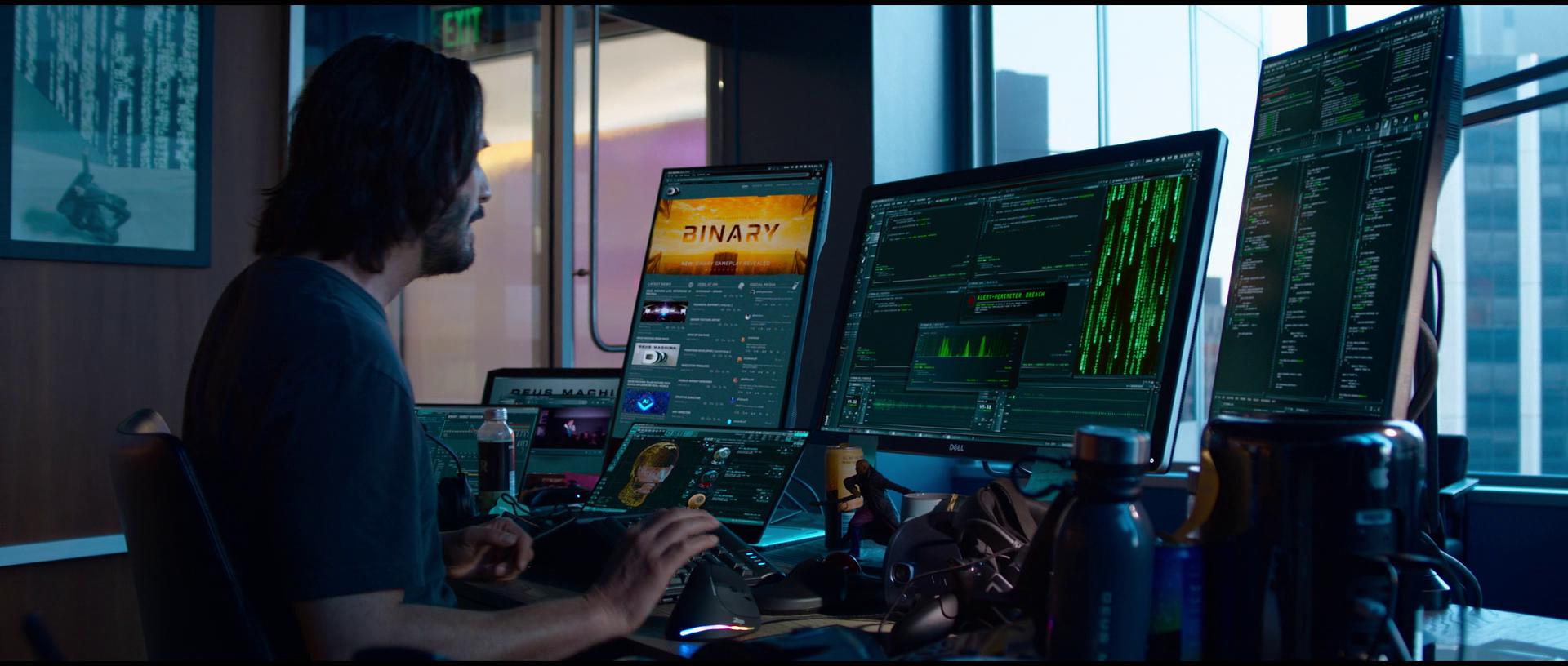
This mirrors the concept of the “Modal” from The Matrix Resurrections—a sandbox simulation used to evolve sentient programs. To deploy robust intelligence to the edge, we effectively train agents in digital “modals” (simulations) to distill their capabilities before “jacking them in” to the physical world. The edge agent is a distilled essence of the cloud supercomputer, stripped of excess but retaining the core causal reasoning.
5. Collective Intelligence: Beyond the Single Device
When individual nodes are constrained, power must emerge from the collective. Gossip Learning protocols allow decentralized devices to train and refine models via peer-to-peer communication, akin to how murmuring starlings coordinate flight without a central commander.
This vision of a Bio-Cognitive Mesh suggests that the supercomputer of the future is not a monolith in a data center, but a transient, ephemeral network formed by the phones in our pockets and the appliances in our homes. The network is the computer.
Epilogue: The Grand Miniaturization
“Honey, I Shrunk the Neural Net” is a playful title, but it masks a serious reality. The next frontier of AI is not larger parameters, but denser reasoning. By embracing the constraints of the edge—power, heat, and bandwidth—we are forcing our artificial creations to adhere to the same physical laws that shaped our own minds.
We are exiting the era of excess and entering the era of elegance. The future of intelligence is quiet, cool, and ubiquitous.
Curious Questions for the Researcher
- The Ghost in the Quantization: When we compress a model by 90%, do we lose noise, or do we lose the latent potential for creativity and “black swan” reasoning?
- The Thermodynamic Limit: Is the brain's 20-watt efficiency a biological limit, or can silicon eventually surpass it by ignoring the requirements of maintaining a biological metabolism?
- Recursive Autonomy: Can a quantized model running on the edge have enough agency to rewrite its own weights, effectively “learning” in real-time without a backward pass?
Resources for the Curious
- [1] Ma, S., et al. (2024). The Era of 1-bit LLMs: All Large Language Models Are in 1.58 Bits. Microsoft Research.
- [2] Hooker, S. (2020). The Hardware Lottery. Google Research.
- [3] Sakana AI. (2024). Evolutionary Model Merge: Swarm Intelligence for Foundation Models.
- [4] Landauer, R. (1961). Irreversibility and Heat Generation in the Computing Process. IBM Journal.